
The Italian Banking System and Bad Debt Issuance – Is It Systemic?
There has recently been renewed concern over the high level of non-performing loans (NPLs) in the Italian banking system and the potential for a systemic contagion. This is not a new risk and as the chart shows, the bulk of these NPLs are from loans to made to business enterprises. Most of these loans turned sour in the period between 2009 and 2013.

Italian Business Insolvencies
Nevertheless, the high level of NPLs has left the major Italian banks undercapitalised, a risk which has not been dealt with decisively by policymakers. This is despite the fact that most of the build-up in bad debts occurred between 2009 and 2013. This undercapitalisation has acted as a constraint on new lending growth in the economy and made it even more challenging (notwithstanding fiscal austerity measures and an overvalued currency as it pertains to the Italian trade sector) for the economy to recover meaningfully in recent years.
As the chart below shows, loan growth to the Italian private sector (non-financial corporation’s) remains negative despite rising demand for credit.

Notwithstanding the negative effects on the Italian economy, it is unlikely that the current crisis will prove systemic. For a banking crisis to be systemic, it requires a bank that is “too large to fail”, given its linkages and interconnectedness with other banks, to become insolvent and fail, as was the case with Lehman in 2008. Furthermore, with loan growth already contracting, the marginal credit impulse from a further contraction is much less meaningful when compared to a situation where such a credit shock occurs in an economy that has in the immediate years preceding the confidence shock experienced high rates of credit growth.
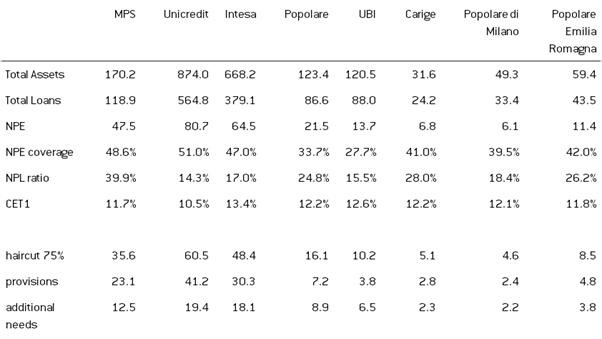
The table below suggests that only one of the country’s three largest and possibly systemic banks is insolvent taking into account an aggressive write down of NPLs. Only Monte Paschi Di Siena (ironically the world’s oldest bank) appears likely insolvent, but even here the capital requirements to effect a “bail-out” would not be overly onerous at around EUR 20bn or 1.2% of Italian GDP.
The recent sharp decline in Italian government bond yields (as a result of the ECB QE) and shorter duration of the country’s outstanding government debt (net at 122% of GDP) suggests that the incremental interest savings could easily cover such a bailout program and not threaten the country’s existing fiscal deficit projections. Banking sector assets in Italy as a proportion of GDP are low, amounting to roughly 80%.
This is in contrast to the situation that prevailed in Ireland during 2008/9 when the banking system in that country became insolvent and total banking assets amounted to roughly 800% of GDP. Even if the entire stock of NPLs in Italy (not provisioned for) was shifted to the public sector balance sheet (roughly EUR 120bn), it would only amount to around 7% of GDP, large but not debilitating.
In contrast, a system-wide NPL ratio of 20% (and only 50% provision coverage) in a country where banking assets are 800% of GDP, would result in a similar state bailout reaching 80% of GDP. This was indeed the experience in Ireland and hence the eventual need for a European bailout program initiated in 2011.
The real risk is mainly confidence related. In the event that senior bondholders are “bailed-in” (in any sector-wide recapitalisation) under the new EU resolution mechanism that came into force on 1 January 2016, this may lead to a general re-pricing of bank borrowing costs in the capital markets (higher). This would further erode the profitability of European banks and crimp lending to the private sector, an additional constraint on the ability of the region to engineer a more durable and robust recovery.