
Chinese Private Sector Credit Growth
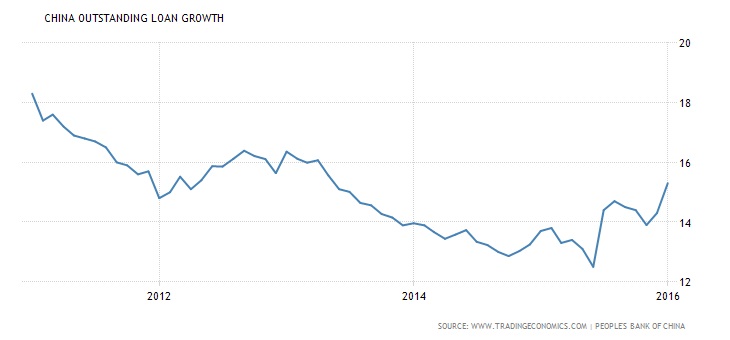
Chinese private sector credit growth or loans extended by the Chinese financial system to businesses and households accelerated to 15.3% y/y in January from 14.3% y/y in December. This is the highest rate of credit growth recorded since early 2013 and provides another indication that a “hard landing” in the Chinese economy is an unlikely scenario for 2016.
Pessimism and concerns over the Chinese economy and banking sector have in recent months escalated and in part, a key narrative driving the general global bearish sentiment towards equity markets. However, it is worth remembering that the Chinese banking system is not directly comparable to those in Western nations. Most of the larger banks remain effectively state-owned, which will make it easier (and very likely) for them to be recapitalized or to raise equity in order to absorb a rise in non-performing loans. It is also worth remembering that the actual write-down or recognition of bad loans are likely to happen very gradually as policymakers and bankers are likely to resist aggressive write-down’s.
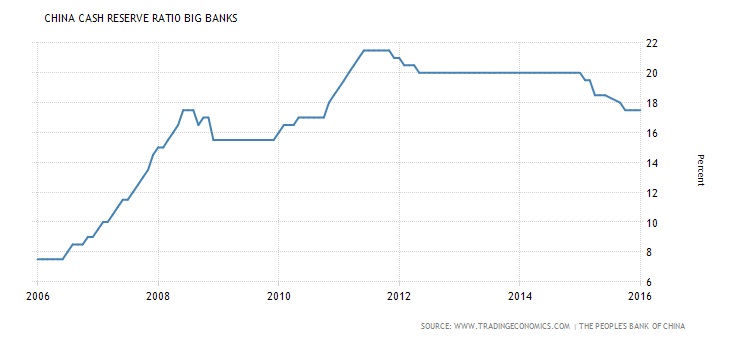
Central bank lending rates at around 4.5% also have room to move lower, while reserve requirement ratios are also far higher than the statutory ratios that prevailed prior to the global financial crisis in 2008. Coupled with a central government that also still has substantial room for fiscal stimulus, the tools available to Chinese policymakers to avoid a hard-landing in the short-term are substantial. To be sure, a return to the double-digit growth rates over the past decade is also unlikely, but overall the Chinese economy will likely continue to grow, supported by stimulus and consumption growth.
Nevertheless, there remain substantial longer-term risks. China’s now ageing demography suggests that the total number of employed workers in the economy is likely to remain flat going forward while the scope for the kind of robust wage growth seen over the past decade also appears limited. China has lost substantial competitiveness as wages increased and its currency (nominally pegged to the US Dollar) gained relative to regional competitors. Stagnant job and wage growth coupled with a political system that is unsustainable in the long-term ( or at least if China wishes to move to even higher levels of income per capita), represents the major risk for China. As USD liquidity continues to tighten over the next few years, the Chinese currency will likely be forced to devalue further over the remainder of the decade, while capital outflows are also likely to persist.
At present, given China’s still large trade surplus and foreign exchange holdings, it is likely policymakers will be able to control the exchange rate for some time to come. Nevertheless, at some point before the end of the decade (very unlikely in 2016), when Chinese growth weakens or slows further coupled with possible rising social and political tensions, the risk of an acceleration in capital outflows could ultimately lead to an even more pronounced devaluation in the currency at some point. This will likely prove to be the key or pivotal moment for China, related financial markets and regional economies in terms of specific event risks.