
Emerging Market Corporate Bond Market
Where do the risks lie?
The recent rise in corporate bond yields (widening in corporate bond spreads) has been one of the factors driving some of the recent negative sentiment towards global equity markets. The recent rise in bond yields, in part driven by a tightening in USD liquidity, has mainly been the result of the deteriorating global growth expectations and specifically earnings expectations in the energy and broader commodity sectors. As such, default risk or the perceived risk of default has risen markedly over the past six months and, in turn, leading to a general re-pricing of risk in the corporate bond market.
Zero interest rates and the large Quantitative Easing (QE) programmes undertaken by the world’s three major central banks (Fed, ECB, BOJ) helped to suppress yields not only on sovereign bonds but also riskier corporate bonds. This inevitably led to a large increase in bond issuance as corporates around the world took advantage of the benign liquidity environment. However, ultimately these bonds will have to be refinanced at some point in the future, and it is the risk of higher rates in the future (therefore funding costs will rise as corporates refinance) that has to some extent been undermining current equity valuations. But what is the risk and where is it specifically concentrated?
Emerging markets were undoubtedly the major beneficiaries of the very accommodative monetary policies implemented by the world’s major global central banks since 2008. As the chart below shows, new debt issuance in emerging markets nearly tripled between 2007 and 2014.
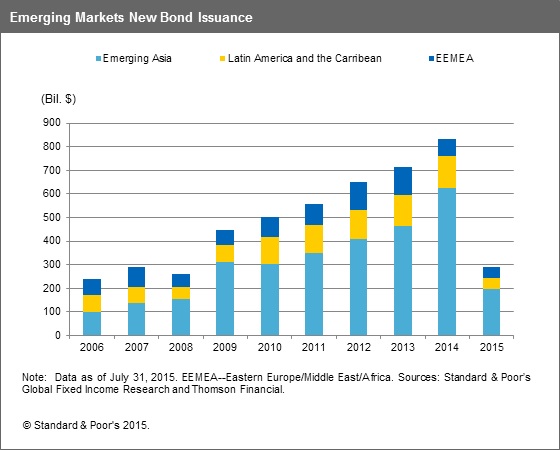
With the average duration of between 4 and 8 years for much of this debt, the refinancing peak according to data compiled by ratings agency, S&P will probably occur between 2017 and 2018.
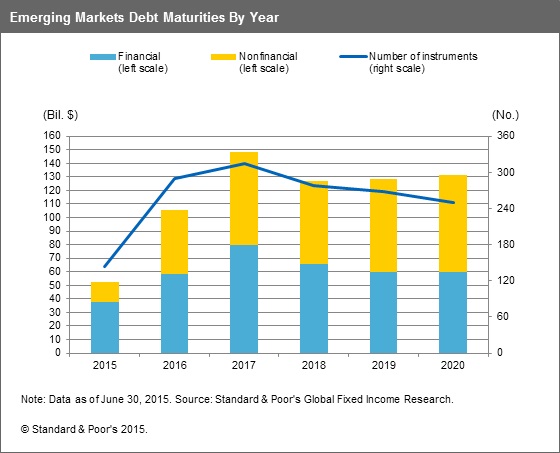
The key question as we look out over the next three years is: “can EM corporates refinance this debt and what level of interest rates?” Undoubtedly, given the deterioration in growth prospects for much of the EM world coupled with a now somewhat tighter global liquidity backdrop, financing rates will be higher than was the case just a few years back. Notably perhaps, there is a significant jump in EM debt maturities related to financial companies in 2017 and 2018. 60% of this debt is from emerging Asia and mainly concentrated by issuers in South Korea, China and Hong Kong.

Although refinancing demands will jump in 2017, in general, financial issuers from the larger emerging Asian countries should be able to absorb modestly higher funding costs without too much trouble. However, taken in the context of a broader expected jump in corporate bond maturities globally (refer to the chart of US debt redemption profile below), spreads are likely to remain much wider (therefore higher yields) than was the case between 2010 and 2014. This will pressure funding costs in the region, eroding the profitability of financial corporates and ultimately leading to tighter credit conditions, a negative for economic growth in the region looking out to 2017 to 2019.

The other key risk associated with the rise in refinancing demand in EM bond markets is currency risk. As S&P emphasises in its most recent report:
“Many emerging-market issuers tapped foreign bond markets and issued debt in foreign currencies, helped by their presences in developed economies. As a result, a large portion of the debt maturing through 2020 is in U.S. dollars (75%) and euros (8%). While this was attractive for emerging-market companies, it led to an increased foreign-exchange risk; the U.S. dollar has strengthened significantly against a number of emerging market currencies, posing a risk to debt service and refinancing in dollars, if local currencies remain suppressed for longer periods.”
Apart from Emerging Asian, Latin American corporates will also experience a large increase in debt maturities, starting in 2016 and extending through to 2019.
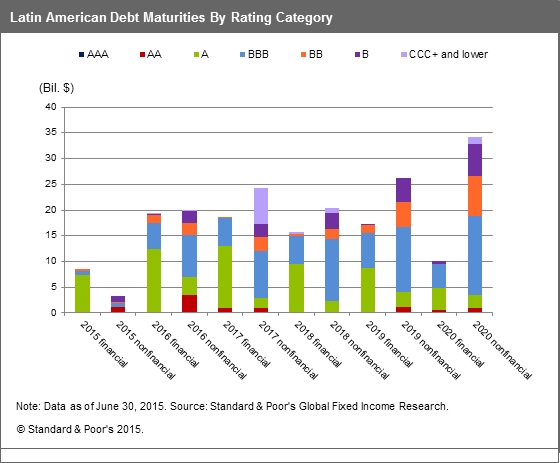
Of particular relevance given the recent decline in oil prices, is an expected rise in debt maturities in the energy sector in Latin America. Deb maturities in this segment will increase from around USD 1bn in 2015 to USD 10bn in 2016 and USD 14bn in 2017. Most or almost all of this is related to the Brazilian state-owned petrochemical company Petrobras, of which 84% is denominated in foreign currencies (mainly USD). It is very likely that Petrobras will require some kind of state assistance from the Brazilian government, but this aid will not come without cost to Brazil’s own sovereign debt risk premiums and ultimately the currency.